How do XRPL AMM pools work?
An XRPL AMM pool holds two assets, such as XRP and RLUSD, and prices every swap from the balance between them. Pools are part of the XRP Ledger protocol and have been live since 22 March 2024. Liquidity providers deposit into a pool, receive LP tokens for their share, and earn the trading fee of up to 1% that each swap pays.
Автор: Rho Black · · 6 мин чтения
What an XRPL AMM pool is
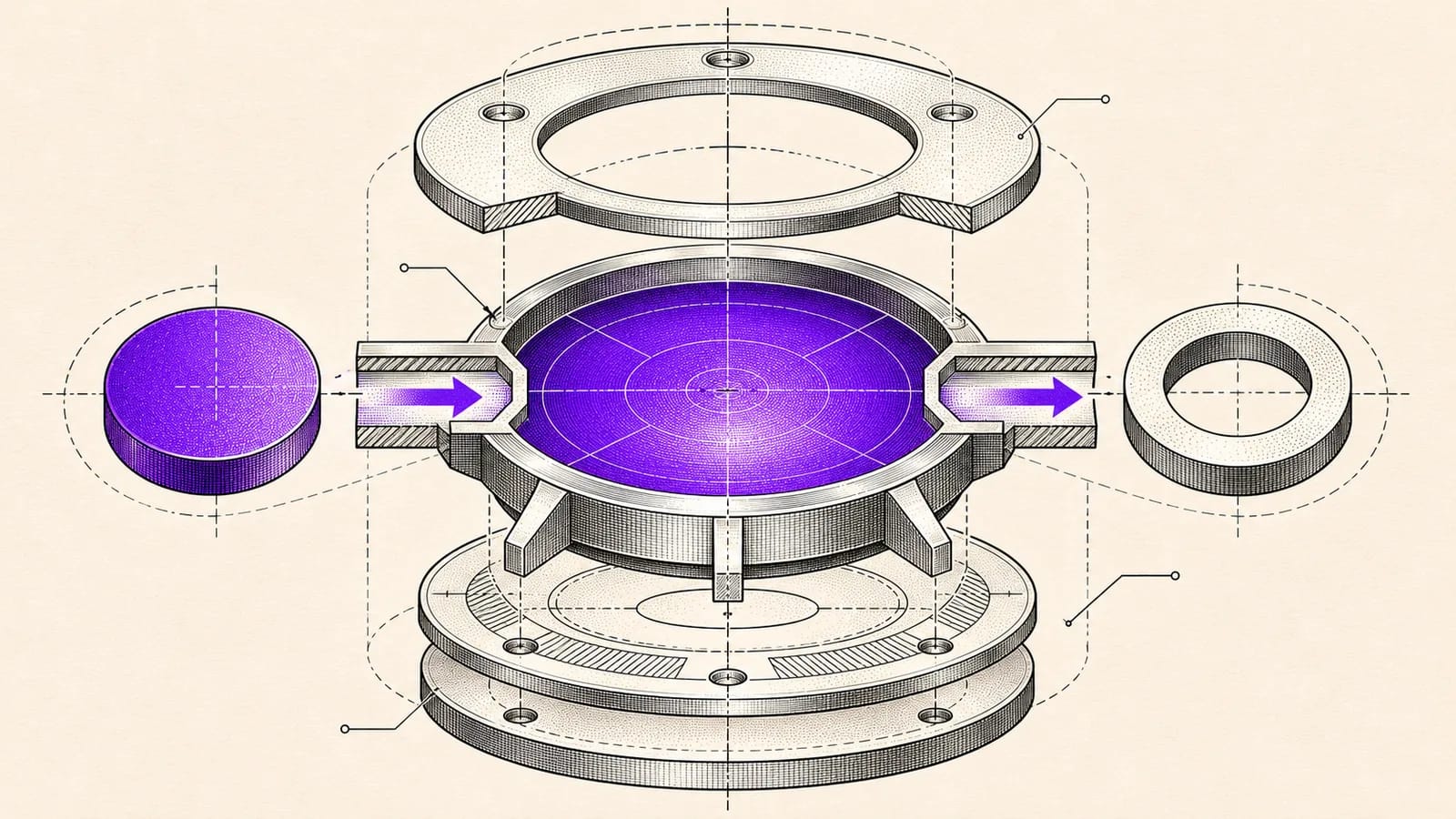
An automated market maker (AMM) is a pool of two assets that anyone can trade against. Instead of waiting for a buyer or seller on the other side, you swap with the pool, and the pool sets the price from the balance between its two assets: the more of one asset traders take out, the more of it each further unit costs.
On most blockchains an AMM is a smart contract that some team wrote and deployed. On the XRP Ledger it is a transaction type in the ledger software, live on mainnet since 22 March 2024.
- There is exactly one pool for each pair of assets, so liquidity for a pair is never split across copies.
- A pool pairs XRP with a token, or two tokens with each other.
- Each pool lives in its own special account on the ledger, which nobody holds the keys to.
- Multi-Purpose Tokens, the ledger’s newer token type, cannot go into pools yet.
How swaps use the pool and the order book
The XRP Ledger also has an order book: a list of buy and sell orders that people placed at prices they chose. The two work together. When you swap or place an order, the ledger fills it from the order book, from an AMM pool, or from a mix of both, whichever gives the better rate. You do not choose between them: a swap on XPMarket uses whatever liquidity is cheapest at that moment.
For liquidity providers this means a pool earns only on the trades, or the parts of trades, where it beats the order book. What you earn per dollar then depends on volume compared with the pool’s size. If more money joins a pool and the volume stays the same, every provider’s share of the fees shrinks.
LP tokens: how liquidity providers earn
When you add assets to a pool you receive LP tokens, which record your share of everything in it. Every swap through the pool pays a trading fee, and that fee stays in the pool, so each LP token is backed by slightly more assets over time.
- Deposit both assets in the pool’s current ratio, or just one of them.
- Receive LP tokens. They sit on a trustline to the pool’s account, the ledger’s opt-in for holding a token. That trustline normally sets aside 0.2 XRP of your balance until you remove it.
- Swaps add their fees to the pool while you hold the LP tokens.
- Return some or all of your LP tokens to withdraw your share of both assets. There is no lock-up.
| Deposit or withdrawal | Fee | When it fits |
|---|---|---|
| Both assets in the pool ratio | None | You already hold both assets |
| One asset only | Charged as if you swapped part of it | You hold only one of the two assets |
The table below shows the largest pools and the fee APR each has earned recently. It updates from the ledger every hour.
Крупнейшие AMM-пулы XRPL сейчас
| Пул | Ликвидность | APR от комиссий | Торговая комиссия |
|---|---|---|---|
| XRP/RLUSD | $3.8M | 1.06% | 0.32% |
| WLBN/XRP | $1.2M | 0.49% | 0.50% |
| FUZZY/XRP | $1.1M | 6.68% | 0.46% |
| XPM/XRP | $442.8K | 0.81% | 0.74% |
| ARMY/XRP | $426.8K | 0.00% | 0.00% |
APR от комиссий переводит недавние торговые комиссии в годовые проценты от ликвидности пула. Он меняется каждый день и не учитывает непостоянные потери.
A very high APR usually means a small pool, a volatile token, or both. Before you deposit, look at the pool’s liquidity and at the token itself: who issues it, how many accounts hold it and whether it trades anywhere else. You can compare every XRPL AMM pool on XPMarket.
What a token issuer can still do
Putting a token in a pool does not take it out of its issuer’s control. If the issuer freezes the token, for you or for everyone, your LP tokens for that pool are frozen too, and you cannot send them to anyone. A freeze for everyone, called a global freeze, also stops you withdrawing that token from the pool until it is lifted. If the issuer has turned on clawback, it can take its token back out of your pool share. You keep your share of the other asset.
Impermanent loss
A pool rebalances as prices move. When one asset gets cheaper, traders sell it into the pool and you end up holding more of it; when it rises, they buy it out and you hold less. Compared with holding both assets in your wallet, you are worse off whichever way the price moves.
Say you deposit 250 XRP at $2 and 500 RLUSD, Ripple’s US dollar stablecoin, and then XRP halves.
| Value of your assets | In a wallet | In the pool |
|---|---|---|
| When you deposit | $1,000 | $1,000 |
| After XRP falls to $1 | $750 | $707 |
On the way down, traders sold XRP into the pool and took RLUSD out, so your share now holds about 354 XRP and 354 RLUSD. Both columns lost value because XRP fell, but the pool share lost $43 more. That gap of 5.7% is the impermanent loss, before any fees the pool earned.
It is called impermanent because it disappears if XRP climbs back to $2. Withdraw before that and the loss becomes real.
A doubling costs the same 5.7% as a halving, and a fourfold move either way costs 20%. That is the number to weigh against the APR: a pool earning 20% a year in fees needs about three and a half months of fees, if that rate holds, to make up for one doubling. Volatile tokens often show high APRs because every price swing brings in arbitrage traders who pay fees, and the same swings create the loss. If a token collapses, traders keep selling it into the pool, and you end up holding mostly the token that failed.
How to add liquidity on XPMarket
- Connect a self-custody XRP Ledger wallet such as Xaman. XPMarket never holds your funds: you sign every transaction yourself.
- Open AMM pools and pick a pool. Check its liquidity, volume and trading fee.
- If the pool holds a token you do not have yet, set a trustline for it first.
- Choose a two-asset or single-asset deposit, enter the amount and sign the deposit in your wallet.
- Withdraw from the same pool page whenever you want your assets back.
On XPMarket, liquidity in eligible pools can also earn XPM, XPMarket’s own token, through XPM farming, on top of the pool’s own fees.
Creating a new pool
If no pool exists for a pair yet, anyone can create one by depositing both assets. The amounts you put in set the starting price, so match the market: if your ratio is off, arbitrage traders will quickly buy the cheap side from you. Creating a pool also destroys 0.2 XRP, and you set the starting trading fee, which liquidity providers can later change by vote.
Who sets the trading fee
Each pool has its own trading fee, between 0% and 1%. Any liquidity provider can vote on it, but only the 8 votes backed by the most LP tokens count. The fee is their average, weighted by LP tokens held, and it changes only when someone votes again.
A high fee sends swaps to the order book, and a low one pays providers little for the risk they carry.
The auction slot
Every pool runs a continuous auction for a 24-hour trading slot. Whoever holds it pays one tenth of the normal trading fee and can share that discount with up to 4 other accounts. The buyers are mostly arbitrage traders, who profit by trading the pool back into line when its price drifts away from other markets.
Bids are paid in LP tokens. Part of a winning bid refunds the holder it displaces, for the time left on their slot. The rest goes back to the pool and stops existing, so every remaining LP token owns a little more of the pool. For you as a provider, the bid is paid in place of the fees the slot holder skips. The more traders compete for the slot, the closer the bid gets to what those fees would have been.
Следующий шаг · AMM-пулы
Compare pools before you deposit.
Every XRPL AMM pool with its liquidity, volume and fee APR.
Частые вопросы
What is a liquidity pool on the XRP Ledger?
A pool of two assets that anyone can swap against, held in an account nobody has the keys to. The XRP Ledger allows only one pool per pair, so all pool liquidity for, say, XRP and RLUSD sits in the same place.
How do I earn fees from an XRPL AMM pool?
Deposit into the pool and you receive LP tokens. Each swap through the pool pays its trading fee into the pool, so your LP tokens redeem for more assets over time. You collect the fees when you return the LP tokens and withdraw.
What is impermanent loss?
What your pool share loses against holding the same assets in your wallet. It grows the further prices move in either direction and disappears if they come back. A price that doubles or halves costs about 5.7% before fees; a fourfold move costs 20%.
Is providing liquidity on the XRP Ledger safe?
No outside team’s contract holds your funds, and you keep your own keys. The ledger code can still have bugs; three weeks after launch, an amendment fixed a bug in how it handled some large pool trades. Day to day, market risk matters more: impermanent loss, the price of both assets, and a token issuer that may be able to freeze its token or claw it back.
Do I need XRP to provide liquidity?
A little. The ledger makes every account keep 1 XRP it cannot spend, plus normally 0.2 XRP for each trustline, including the one that holds your LP tokens, and each transaction destroys a tiny fee. The pool itself can pair two tokens without XRP.
Источники
- XRPL.org: Automated Market Makers
- XRPL.org: AMMDeposit
- XRPL.org: AMMVote
- XRPL.org: AMMBid
- XRPL.org: AMMCreate
- XRPL.org: AMMClawback
- XRPL.org: Known Amendments
- XRPL.org: Reserves
Ссылки на XPMarket ведут на собственные продукты XPMarket. XPMarket не хранит средства пользователей: вы подписываете каждую транзакцию в своём кошельке. Это руководство носит образовательный характер и не является финансовой рекомендацией.
Читать дальше
Can you stake XRP?
XRP has no native staking. Where XRP yield really comes from, what each option pays and what can go wrong.
6 мин чтения · Обновлено 23 нояб. 2026 г.
What is DeFi on the XRP Ledger?
What DeFi on the XRP Ledger is: a built-in exchange, AMM pools, escrow, checks and payment channels, what is live today, what is still missing and the risks.
4 мин чтения · Обновлено 23 нояб. 2026 г.